Ballet Body Image Crisis: The Impact of Competition Aesthetics on Young Dancers
26th February, 2026
By Yuhua Emma Zhang
One of my first horrors in ballet, when I was 12, was meeting a malnourished, eating disorder stricken girl. A girl, who had only lived for 9 years in her life, was plagued with a life-threatening metabolic issue due to the radical changes in ballet aesthetics in recent years. Looking back on this eye-opening experience, my then astonished feeling of horror is now replaced by a genuinely deep empathy for how her situation reveals a systemic issue in the classical ballet community: do aesthetics prevail over human enjoyment for an art that profits off of superficial ideals of “wellness” when its own dancers face unfathomable stress and health issues? How do these pursuit of aesthetics also affect natural aspects in a dancer's body? How have ballet competitions accelerated this process of aestheticism over everything else, and why do the people in power get to decide on what makes something “aesthetic”?
Entranced by the soft glow of competition stages, I found myself not dancing in the moment of my many competition seasons; instead, they filled my everlasting doubt of the system that I contributed to. I hopelessly worried about whether attending these competitions meant letting the Girl I had Met’s legacy go to waste: did her efforts in all of this at such a young age be turned a blind eye by everyone around her? And in the middle of it all, as I stood there, in my Le Corsaire costume, examining the lithe figures of the girls I danced with, my name was called by the announcer, and I was soon whisked away in the unsurprising demeanor of how I played into the system.
Specifically to answer my first question of aesthetic enjoyment over human wellness, eating disorders have plagued the ballet world for decades on end, beginning with the extremist standards of George Balanchine. Before the American style of the 1960s, classical ballet in the French and Russian styles had extremely balanced bodies that retained the curves of the natural female body. However, as time progressed, rail thin dancers that resembled the body shape of males instead of females became the norm, and now as we head into the 21st century, ballet standards have been blown out of proportion. Along with the over saturation of perfection that is present on social media, ballet has overemphasized the importance of natural aspects to a dancer over technique: there can be long limbs, a small head, extreme arches with high insteps, or injury inducing hyper extension, these qualities are all present and hyperconcentrated in the dance world, and more specifically, ballet competitions. The pursuit of these aesthetics is most present in ballet competition scoring, where if two dancers have similar skill levels, the girl who might have the upper hand in natural aspects might place 1st, while the other, might place 12th or 24th (from what I have observed). Especially when it comes to high insteps, judges often dismiss anatomical limits (such as a girl with flat feet and ankle injuries), and judge them as “untrained” or “lazy” when it is only to the best of the ability of a girl. This apathy towards a dancer’s natural ability often leads to an unhealthy pursuit of an unchangeable aspect, and can lead to nerve damage in the feet from overstretching or weak knee joints from extreme force for hyper extension. Of course, I acknowledge the elementary needs of aestheticism in ballet since it is classified as an art (as all art has its aesthetic requirements), but there comes a point where aestheticism ruins the joy of ballet and its technical wonder, and is then replaced by a cold, perfected dancer with all the possible aesthetics, but lacks a soul when dancing. Thus, I have seen this phenomenon at multiple ballet competitions I have attended, where a cold, stark contrast lights up the stage in between a genetically gifted dancer versus someone who dances with their soul but might lack certain anatomical gifts.
Now back to the eating disorders, my distaste for the amount of self-proclaimed dance anatomist gurus on social media who specialize in biomechanics is not based on annoyance, but off of the spread of misinformation. Especially when it pertains to eating disorders, they criticize it to harm the body of a dancer but then promote certain bodies that legitimately look starved and propagate a deep seated insecurity for many. Predominantly in ballet competition circles, this lack of acknowledgement of eating disorders contradicts their mission goals, and ultimately leads back to the question of if aestheticism overrides health and the joy of dancing. From the girl I noticed, she placed consistently 1st and 2nd place at a specific ballet competition, and was posted consistently for her “gorgeous talented lines”, but after her battle with eating disorders came out, she was subsequently hospitalized. The ballet competition did not wish her a farewell. They had not wished her anything, and her eating disorder was immediately swept under the rug with her performances dismissed. They instead replaced her with the next little girl with alarmingly high extensions, thin legs, and a noticeable ribcage under her leotard. Sitting in the audience during the awards ceremonies, I noticed each girl that was promoted to the top 12 fit the standard mold almost exactly, and the one common notion that matched all of them was obvious: a frail frame that looked like it was on the edge of malnourishment.
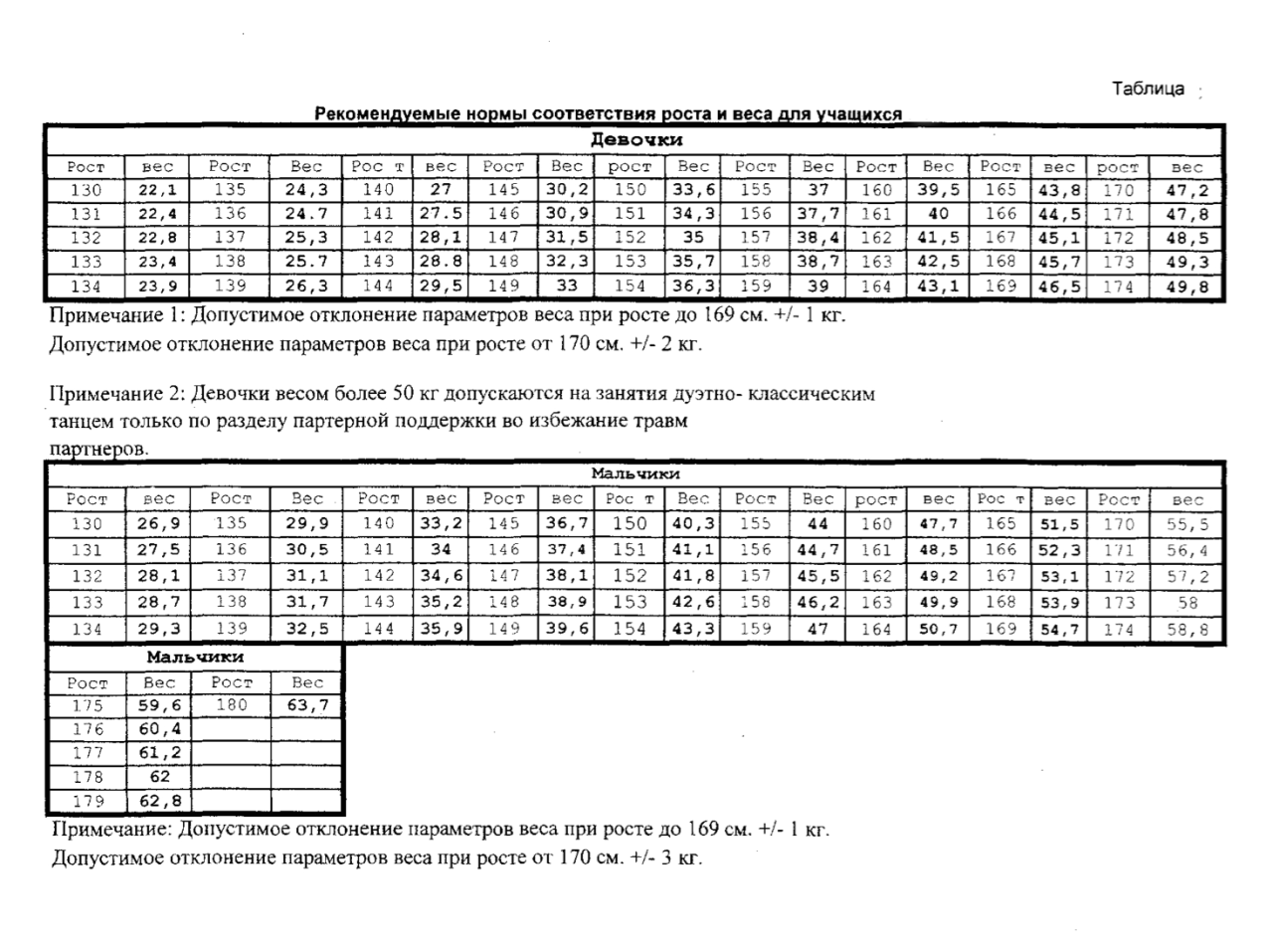
Vaganova Ballet Academy Height/Weight Chart- written on the chart proclaims a girl of height 165 should be 43.8 kg, which is a BMI of 16.1, where the lowest healthy BMI is 18.5 (this also does not account for muscle mass)
I was quite disappointed to say the least. Why would any organization promote health, joy, and wellness on social media completely promote a body image built on anorexic young girls that sacrifice their meals to win medals? What barbaric system does this implicate?
Finally, the judging panel at these competitions, including leadership at ballet companies love to promote “body inclusivity” but spiral back towards an unhealthy ideal that limits dancers to terrible bmi outcomes. Statistics report that over 20% of adolescent dancers have some form of eating disorder, and in my perspective, scholarship offers from these panels at ballet competitions overrepresent this statistic. I often see scholarship winners present the same low bmi that often results not only in a life-long battle with food, but osteoporosis. This creates a cycle where, “Osteoporosis causes bones to become weak and brittle — so brittle that a fall or even mild stresses such as bending over or coughing can cause a break” (Mayo Clinic). Due to the lack of nutrients, and weight riding on top of these young dancers' tendons while they go through puberty, the result are low-density bones that can detach easily when they reach old age. However, this issue is never spoken about.
In the end, I do not question the existence of aesthetics in ballet — I question the hierarchy that places them above humanity. Ballet was once an art that celebrated discipline, musicality, and emotional transcendence. Yet somewhere along the way, its pursuit of visual perfection eclipsed its devotion to the dancer as a living, breathing individual; an art that sacrifices its dancers for aesthetics will eventually find itself performing to an empty stage.
For Further Reading
If this piece resonated with you, I highly recommend picking up Gelsey Kirkland's autobiography Dancing on My Grave. Kirkland, a principal dancer at the New York City Ballet under George Balanchine, details how Balanchine's obsession with the ultra-thin aesthetic created a culture of disordered eating that rippled through generations of dancers. Her account looks at exactly the systemic issue I've described here, and it makes clear that this problem did not emerge overnight.
Title Image Credit: New York City Ballet production of "The Goldberg Variations" with Gelsey Kirkland, choreography by Jerome Robbins (New York), 1971. New York Public Library Digital Collections. Retrieved from https://digitalcollections.nypl.org/items/7cac0280-47a9-0135-8060-4181db9274fd
